If you run a plumbing company, a law firm, a dental office, or any business where the serious buyers pick up the phone, there's a good chance your Google Ads account is blind to your best leads. I've audited service businesses whose form tracking was spotless while the phone, the channel that actually books the jobs, reported nothing. Google then optimizes toward cheap form fills while your best leads never make it into the math.
Why do phone calls go untracked in most Google Ads accounts?
Because Google Ads only measures what you explicitly wire up, and a call doesn't leave the tidy browser trail a form fill does. A form submit lands on a thank-you page and fires a tag. A call happens on a handset, off the website, sometimes two days after the click, from a number someone wrote on a sticky note.
The consequence is worse than a reporting gap. Smart Bidding learns from whatever conversions you feed it. Feed it forms only and it hunts form-fillers, often tire-kickers, while the high-intent callers get priced out of your own auction. You end up paying more for worse leads and the account looks fine on paper.

| Call assets, free | Website number, free | DNI platform, paid |
|---|---|---|
| Only calls placed from the ad itself | Swaps the number for Google Ads clicks | Every call, from every channel |
| Google forwarding number measures it | Misses SEO, Maps and Facebook callers | Ties the call to the session and gclid |
| 60-second default minimum duration | No recordings, no call outcomes | Recording, transcription, spam filter |
| Website callers stay invisible | A blocked script means no conversion | Priced by numbers and minutes |
What does Google's free built-in call tracking cover?
Google's built-in option is call assets (the feature formerly called call extensions) with call reporting turned on. With call reporting on, Google swaps your number on the ad for a Google forwarding number that passes the call through to yours while measuring it. You then create a "calls from ads" conversion action and set a minimum duration; the default is 60 seconds, and anything shorter doesn't count.
It's free and takes ten minutes. It's also narrow. It only covers calls placed from the ad itself, the tap-to-call button on the search results page. The far bigger pool, people who clicked through to your site and dialed the number in your header, is invisible to it. Call reporting also isn't available in every country.
How do I track calls from my website with a Google forwarding number?
Create a "calls to a phone number on your website" conversion action and install the phone snippet Google gives you. For visitors who arrived from a Google ad, the snippet swaps the number displayed on your page with a Google forwarding number, so the call gets measured and attributed back to the campaign that drove it. Everyone else sees your real number.
Same duration threshold applies, still free. The limits: it only works for Google Ads traffic, so calls driven by SEO, Maps, or Facebook stay dark. You get duration and caller area code, not recordings or outcomes. And if the swap script gets blocked or loads late, the visitor dials your real line and the conversion never exists. I'll come back to that one.
Does click-to-call tracking on mobile actually prove anything?
Tap tracking counts intent, not conversations. In GTM you set up a Just Links click trigger with the condition Click URL contains "tel:", fire a GA4 event like click_to_call, and import it to Google Ads if you want. Every tap is measured, on any traffic source, no forwarding numbers involved.
Here's what a tap doesn't prove: that the call connected, that anyone spoke, that it wasn't a misdial canceled at the confirmation prompt. On desktop, a click on a tel: link might just open a "no app can handle this" dialog. Treat click-to-call as a secondary conversion, useful for spotting which pages make phones ring, and keep it out of your primary Smart Bidding signal.
When do you need dynamic number insertion (DNI)?
You need a call-tracking platform with dynamic number insertion when you want every call, from every channel, tied to the exact visitor session that produced it. Platforms in this category (CallRail, CallTrackingMetrics, WhatConverts and similar) hold a pool of tracking numbers and show each website visitor a different one via JavaScript. When a call comes in on number 14, the platform knows which session was looking at number 14, so it can attach the source, the campaign, the gclid, the landing page, sometimes the keyword.
The category typically adds recording, transcription, spam filtering, and CRM integrations, priced monthly by numbers and minutes. If a meaningful share of your leads call, it's usually the first paid tracking tool that clearly earns its cost.

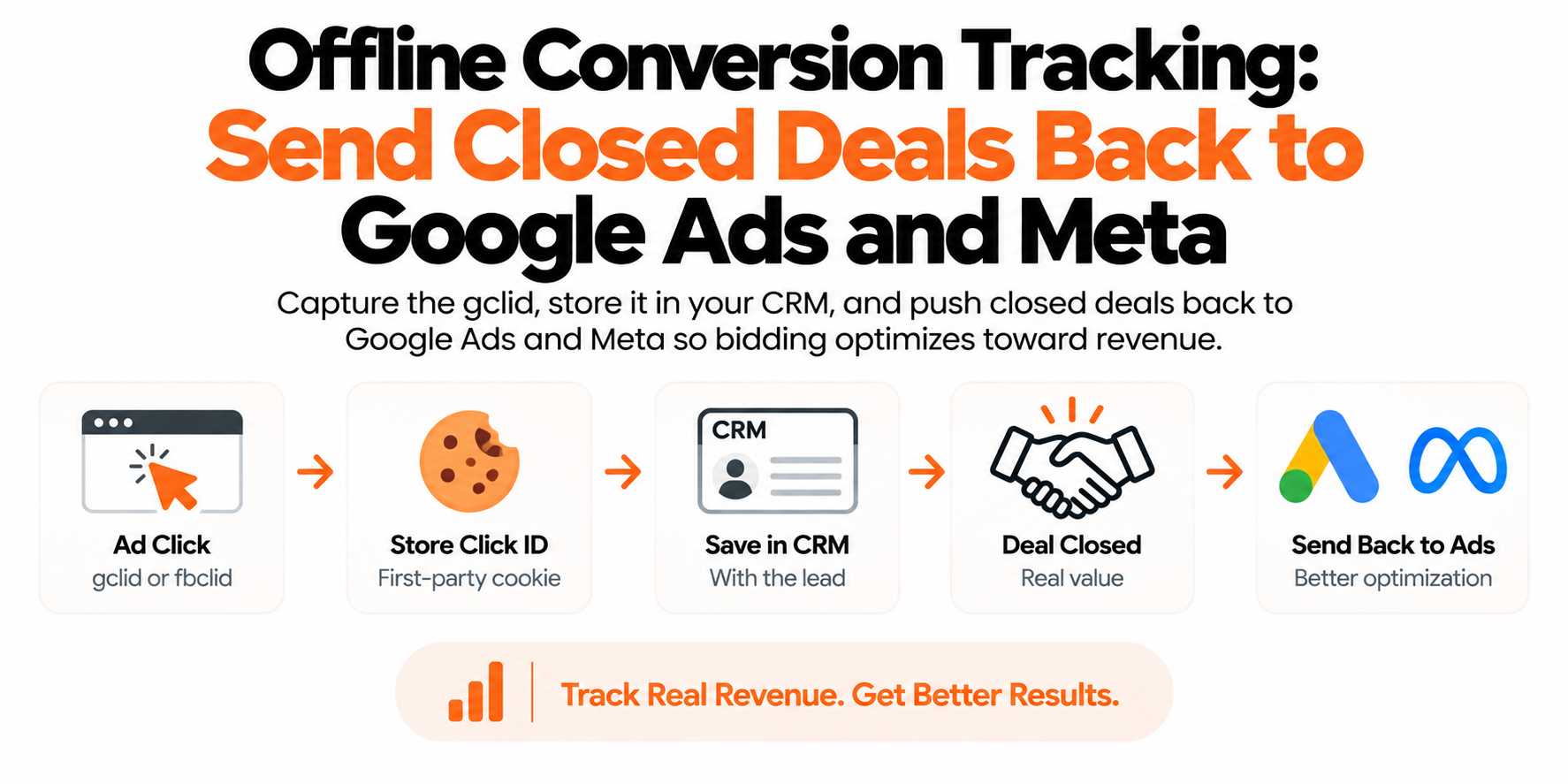
- Capture the gclid at landing — Store it in a first-party cookie so it outlives the first pageview
- Log the click ID with the call — Your call platform or CRM attaches it to the caller record
- Disposition every call — Booked, quoted, wrong number, spam, existing customer
- Upload the qualified calls — gclid with conversion time and value, or enhanced conversions for leads
- Bid on qualified calls — Point Smart Bidding at the booked-call action, not the raw-call one
How do you send call outcomes back to Google Ads as offline conversions?
You upload qualified calls as offline conversions, because a 30-second wrong number is not equal to a booked $4,000 job and Google shouldn't learn from them equally. This is the endgame.
The build looks like this:
- Capture the
gclid(Google's click ID) when the visitor lands, and store it in a first-party cookie so it survives past the first pageview. - When a call comes in, your call platform or CRM logs it with that click ID attached to the caller record.
- Your team disposition the call: booked, quoted, wrong number, spam, existing customer.
- Push the good outcomes back to Google, either by uploading the
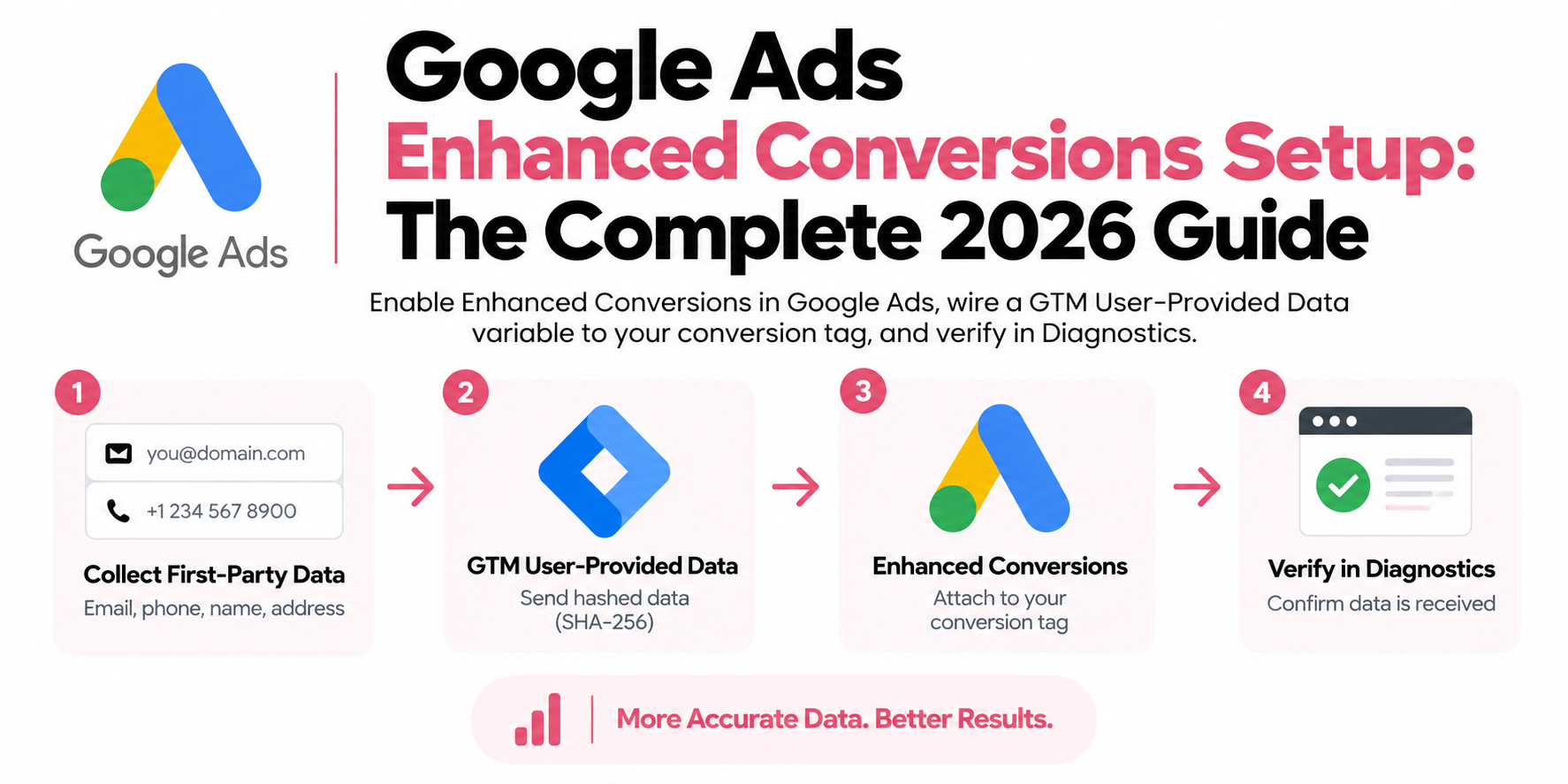
gclidwith a conversion time and value, or through enhanced conversions for leads, which matches on the caller's hashed phone number or email when you don't have a click ID. - Point Smart Bidding at the qualified-call conversion, not the raw-call one.
Now the algorithm optimizes toward people who book, and call value stops being a guess. On lead-gen builds I've done, this step is the difference between "we get calls" and knowing which campaign produces booked revenue.

- Monday: ad click — gclid exists only in the first pageview URL
- JavaScript cookie — Safari's ITP caps it at about seven days
- Thursday next week — She calls - no click ID left to attach
- Untracked call — Google Ads never learns which ad booked it
- Server-set cookie — First-party and long-lived: the call ties back
Why does first-party server-side tracking decide whether any of this works?
Because the entire chain above hangs on one fragile thing: catching the click ID in the browser and keeping it alive until the call happens. That's exactly where browser-based tracking fails. The gclid only exists in the URL of the first pageview. Ad blockers kill number-swap and analytics scripts outright. Safari's ITP caps cookies set by JavaScript at about seven days, so the homeowner who browses your site on Monday and calls Thursday of next week has already lost the thread connecting her call to your ad.
Plain language, since most store and service-business owners have never heard the phrase: server-side tracking means your measurement runs through a small server you own, on your own subdomain (something like track.yourbusiness.com), instead of relying on scripts in the visitor's browser calling out to Google's domains. The browser talks to your domain, first-party, and your server relays clean data to Google Ads and GA4.
For call tracking specifically, that gets you three things. The click ID gets captured and stored in a first-party cookie with a real lifetime, so the Thursday caller still ties back to Monday's ad click. The signal survives ad blockers and browser privacy limits that silently eat browser-only setups. And you get one server-side source of truth feeding Google Ads, GA4, and your call platform the same deduplicated data, so calls, forms, and imports finally agree instead of triple-counting or vanishing. Without that foundation, DNI and offline imports leak at every joint. With it, the numbers hold.
Frequently asked questions
How do I track phone calls from Google Ads for free?
Turn on call reporting for your call assets, create a "calls from ads" conversion action, and add the "calls from website" conversion with Google's forwarding-number snippet. Both are free.
What counts as a phone call conversion in Google Ads?
A call through a Google forwarding number that lasts past your minimum duration (60 seconds by default, adjustable), or a call you import as an offline conversion. Shorter calls are recorded but not counted as conversions.
Do I need a paid call-tracking platform like CallRail?
If calls are a major lead source and you want session-level attribution across every channel, plus recordings and call outcomes, yes, that's what the category is for. If you only need to count calls from Google Ads, the free built-in options cover you.
Does dynamic number insertion hurt local SEO?
Not if you do it right. Keep your real number in your Google Business Profile, schema, and citations, and let DNI swap numbers via JavaScript only for tracked website sessions. Never publish tracking numbers as your official business number.
Can I tell Google Ads which calls became customers?
Yes. Upload qualified calls as offline conversions using the stored gclid, or use enhanced conversions for leads to match on the caller's hashed phone number or email. Then bid toward that conversion instead of raw calls.
Why does Google Ads report fewer calls than my phone actually received?
Common causes: calls shorter than your minimum duration, calls from channels the forwarding number doesn't cover, and the number-swap script being blocked by ad blockers. A first-party server-side setup closes most of that gap.