I make money fixing conversion tracking, so you'd expect this article to end with "hire someone." It won't. A decent share of the setups I audit could have been handled by the owner with a free weekend and the platform docs. The rest are a different story.
When does it make sense to fix your tracking yourself?
DIY makes sense when you're on a single ad platform, a standard theme, and a native integration already covers most of the work. The clearest case is Shopify: the official Facebook & Instagram app sends both Pixel and Conversions API events for standard events like Purchase and AddToCart, with event_id deduplication handled. The Google & YouTube app does the equivalent for GA4. If that's your whole stack, you'd be paying a specialist to click through screens you could click yourself.
The honest checklist for going DIY:
- One platform. Meta only, or Google only. Not both, not yet.
- Standard theme, standard checkout. No custom checkout, no upsell apps, no headless build.
- Spend where a bad week stings but doesn't wreck the quarter. A few hundred dollars a month rarely justifies a paid engagement.
- Time to verify. The one people skip. Setting up a tag takes an hour. Confirming it fires once per purchase with the right value takes another evening.
Verification is completely doable solo. Meta's Test Events tab shows events arriving in real time, GA4's DebugView does the same on the Google side, and Tag Assistant shows what fired and why. Run a real test purchase. Watch it land once, not twice. If you can do that, you don't need me. And you'll be able to debug your own setup at 11pm on launch night.

| Do it yourself | Hire a specialist |
|---|---|
| One ad platform — Meta or Google | Meta + Google + TikTok on one event |
| Standard theme, standard checkout | Consent Mode v2 plus server-side |
| Native app handles Pixel + CAPI | Custom checkout, upsells, funnels |
| Spend a bad week can survive | A broken week outprices the fee |
| Time to verify with Test Events |
When does hiring a specialist actually pay off?
Hiring pays off when the failure modes get invisible: multi-platform deduplication, consent interacting with server-side tagging, custom funnels, and spend levels where downtime is expensive. None of these are about intelligence. They're about how many moving parts have to agree.
Multi-platform dedup. Meta wants the same event_id on the browser Pixel event and the CAPI event so it can merge them. Google Ads Enhanced Conversions runs on hashed first-party data instead. TikTok's Events API has its own event ID rules again. Each platform is manageable alone. Wired together through one GTM setup, they fail quietly: a mismatched event_id double-counts purchases, and your dashboard looks better while your data gets worse. Broken tracking that looks broken gets fixed. Broken tracking that inflates ROAS gets scaled.
Consent plus server-side. Consent Mode v2 has been enforced for EEA traffic for over two years, and it doesn't stop at the browser. The consent state has to travel with the hit into your server container, and every outgoing tag there has to respect it. I've audited setups where the cookie banner blocked the GTM loader entirely: zero data from anyone, consented or not. And the opposite, a server container forwarding EEA hits that should never have left the building. Both failures are silent in your reports.
Custom funnels. ClickFunnels, GoHighLevel, Kajabi, post-purchase upsells on Shopify: these fire confirmation pages in ways standard integrations don't expect. The classic symptom is a Purchase event on the upsell page re-firing the original order total, so you report revenue you never made.
The spend math. This one's just arithmetic. Spend $300 a day and let your Purchase event silently break for ten days, and that's $3,000 of delivery optimized against bad data. Once a plausible broken stretch costs more than a specialist engagement, the decision has made itself.

- Audit on read-only access — Container, Events Manager, GA4 and consent flow reviewed before anyone quotes a price
- Prioritized fixes, worst first — A duplicate Purchase outranks a missing ViewContent, staged so you see each fix land
- Verification you can watch — A real test purchase traced end to end, dedup confirmed, DebugView clean, EMQ checked
- Documentation and ownership — Written record of changes, and every container and pixel stays in your own accounts
What does a good specialist engagement actually look like?
A good engagement runs audit, prioritized fixes, verification, then documentation, in that order. Use this sequence to vet any provider, including us.
- Audit first, with read-only access. The provider looks at your GTM container, Events Manager, GA4 property, and consent flow before quoting anything. The output is written findings ranked by impact. Anyone who quotes a full rebuild before seeing your container is guessing.
- Prioritized fixes, worst first. A duplicate
Purchaseoutranks a missingViewContent. Fixes should be staged so you can see each one land. A teardown-and-rebuild is sometimes right, but it should be justified, not the default. - Verification you can watch. A real test purchase traced end to end: Tag Assistant on the page, Test Events showing browser and server events arriving with matching IDs, dedup confirmed in Events Manager, DebugView clean on the GA4 side, Event Match Quality checked. "The tag is published" is not verification.
- Documentation and ownership. A written record of what changed and how to re-check it, and every account stays yours: the GTM container, the pixel, the server container on Stape or wherever it lives. You should be able to fire the provider tomorrow and lose nothing.
What are the red flags when hiring a tracking specialist?
The biggest red flag is a price before an audit. A few more worth walking away from:
- Guaranteed ROAS improvements. Fixing tracking improves the data your campaigns learn from. Nobody can promise what the ad platform does with it.
- Accounts created under their ownership. If the GTM or server container lives in their account, you're renting your own tracking. I inherit this mess constantly.
- No verification step in the proposal. If the deliverable is "tags installed" rather than "events verified deduplicating," you're buying the cheap half of the job.
- Can't explain deduplication in plain language. Ask how Meta matches a browser event to a server event. If the answer is tool names instead of a mechanism, keep looking.
- No mention of consent. Anyone touching EEA traffic in 2026 who doesn't bring up Consent Mode v2 unprompted hasn't been paying attention.

- Mismatched event_id — Browser and server copies never merge
- Purchases double — Events Manager counts one order twice
- Reported ROAS rises — The campaign looks like a winner
- Budget follows it — Spend moves to the inflated campaign
- Delivery learns — Weeks of optimization trained on it
What does getting it wrong actually cost?
The cost is a chain of mechanisms, not a scary headline number. Duplicate purchases inflate reported ROAS, so budget flows toward campaigns that only look like winners. Missing or under-matched events starve the platform's optimization, so delivery drifts toward worse-fit users. Both errors compound, because Meta and Google learn from the conversion data you feed them: a broken week doesn't just lose that week's numbers, it trains the next several weeks of delivery on garbage.
The nastiest version is the quiet one. Over-aggressive deduplication, or a consent misfire dropping a chunk of your events, doesn't throw an error anywhere. Your campaigns just gradually get more expensive and nobody can say why.
DIY or hire: the short version
| Your situation | Sensible call |
|---|---|
| One platform, standard Shopify/Woo theme, native integration | DIY |
| Low spend, time to learn and verify your own setup | DIY |
| Meta + Google + TikTok all firing on the same events | Hire |
| EEA traffic with a consent banner and server-side tagging | Hire |
| Custom checkout, upsells, or a funnel builder in the mix | Hire |
| Spend high enough that a broken week outprices the engagement | Hire, yesterday |
One honest middle path: DIY the setup, then pay for a one-time audit to confirm it. Cheapest way to buy certainty.
Whichever path you choose, aim it at first-party server-side tracking
DIY or specialist, the destination architecture is the same — so it's worth naming. The setups that hold up in 2026 collect data first-party, on the site's own subdomain, with a server layer carrying the money events. That's what survives ad blockers, keeps cookies alive past Safari's limits, feeds every platform from one deduplicated source of truth, and gives you an actual switchboard for consent instead of hoping each vendor behaves.
If you're going the DIY route, build toward that from day one — a browser-only setup you'll have to rip out in a year is effort spent twice. And if you're evaluating specialists, this doubles as a filter: ask each candidate how they'd structure first-party data capture and server-side delivery for your stack. The ones who answer specifically are the ones worth paying. Correctly wiring that layer is most of what a good engagement is.
Frequently asked questions
Should I hire someone to fix my conversion tracking or do it myself?
DIY it if you're on one ad platform with a standard theme and a native integration. Hire once you're deduplicating events across platforms, handling Consent Mode v2 with server-side tagging, or spending enough that broken data gets expensive fast.
How much does it cost to hire a conversion tracking specialist?
It varies widely with scope, from a single-platform fix to a full multi-platform server-side build. A legitimate provider quotes after auditing your actual setup, not before.
How do I know if my conversion tracking is broken?
Compare purchases in your store admin against Events Manager and GA4 for the same period. Big gaps in either direction, duplicate events in Meta's Test Events tab, or ad-platform revenue exceeding real revenue are all clear signals.
Is Shopify's native Meta integration good enough on its own?
For a standard theme with Meta as your only ad platform, usually yes: it sends Pixel and CAPI events with deduplication handled. It stops being enough when you add more platforms, a custom checkout, upsell apps, or strict consent requirements.
What should a conversion tracking audit include?
A review of your GTM container, pixel and CAPI events, deduplication, GA4 configuration, and consent flow, delivered as written findings ranked by impact.
Do I need server-side tracking to run ads in 2026?
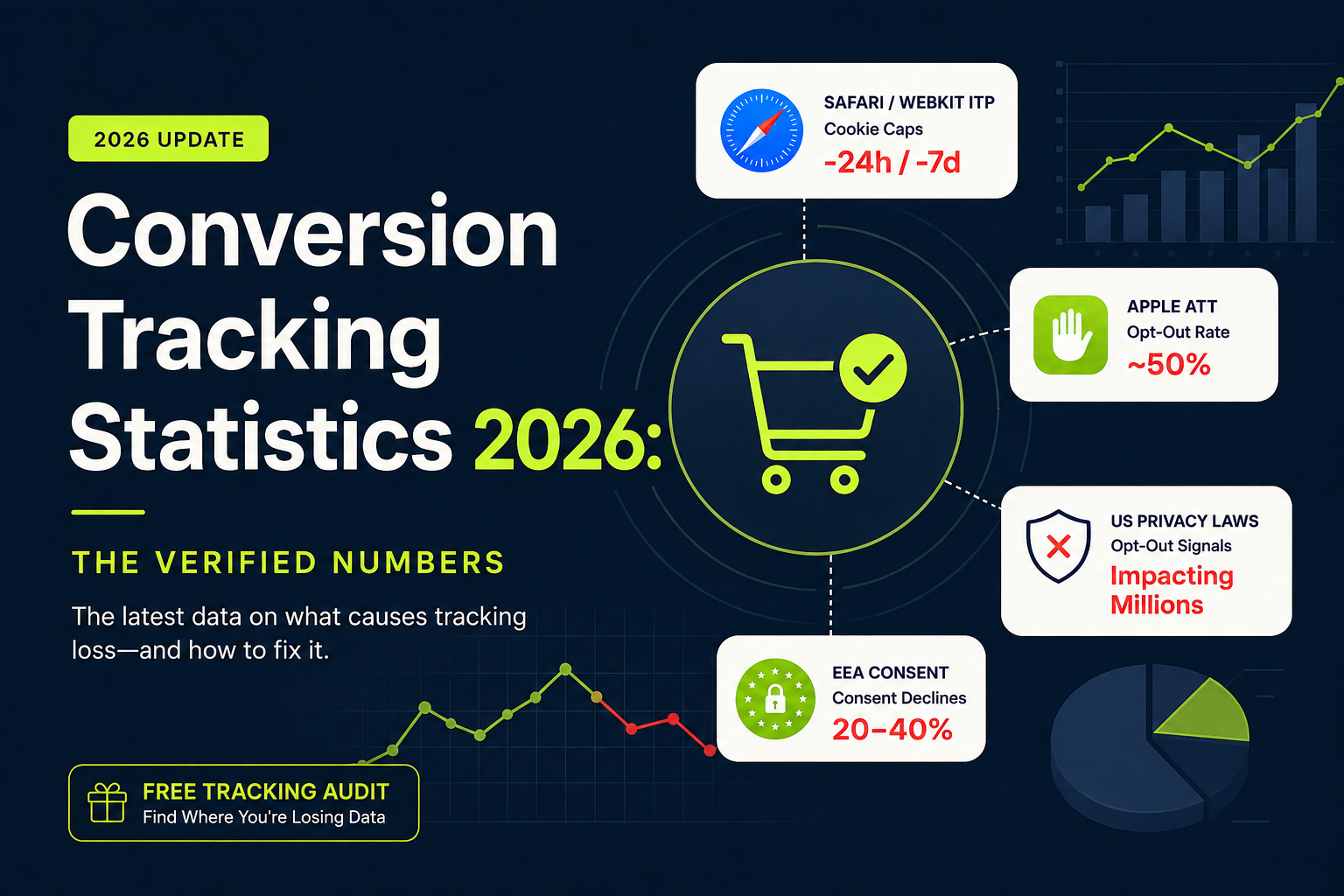
Not always, but browser-only tracking loses events to ad blockers, Safari's ITP cookie limits, and consent declines. Once your spend justifies caring about that lost slice, server-side with proper deduplication is the standard fix.
What access does a tracking specialist need?
Read access to GTM, Events Manager, and GA4 for the audit, then edit access for the fix, always on accounts you own, never theirs.